Semester project - optical computing

This project was conducted at the Laboratory of Applied Photonic Devices (LAPD) at EPFL during the summer of 2025 as a full-time research effort. It focused on developing a new generation of optical computing tools based on Spatial Light Modulators (SLMs) and AI-driven generative models, with the objective of creating a complete pipeline that converts a target optical function into physical SLM masks and predicts the corresponding light pattern. The idea behind the development of this project is to enhance hardware’ s capabilities. With the fast-paced development of AI, classical hardware struggles to keep up with the growing need for faster and more energy efficient devices. In today’s systems, most of the energy and latency come from the shuttling of data between the device and the host. Optics technologies are regarded as a major keystone for the future development of datacenters, devices and components. They offer high bandwidth, low-latency, and low-energy transformations at the unmatchable speed of light.

By combining Variational Auto-Encoders (VAEs) and Latent Diffusion Models (LDMs), the system learns to design optical masks directly from data, bypassing slow physics simulations. This enables the generation of diverse, hardware-aware masks that perform specific optical functions efficiently, demonstrating how machine learning can accelerate energy-efficient, high-speed optical information processing.

Pipeline overview showing the connection between the VAE, diffusion model, and conditioning strategy. Pipeline overview showing the connection between the VAE, diffusion model, and conditioning strategy.

Two optical setups were explored during the project. The first, a compact “zigzag” configuration, uses a gold-coated glass slab to reflect light multiple times within a small space, paving the way for integrated optical computing. The second setup, shown below, is a robust multi-plane SLM configuration that offers greater flexibility and precision for data acquisition and model training.

Optical setup with laser, SLM, mirror, and camera used for multi-plane optical data acquisition. Optical setup with laser, SLM, mirror, and camera used for multi-plane optical data acquisition.

On the software side, a full AI pipeline was implemented:

Example input SLM mask showing small feature patterns used for training. Example input SLM mask showing small feature patterns used for training.

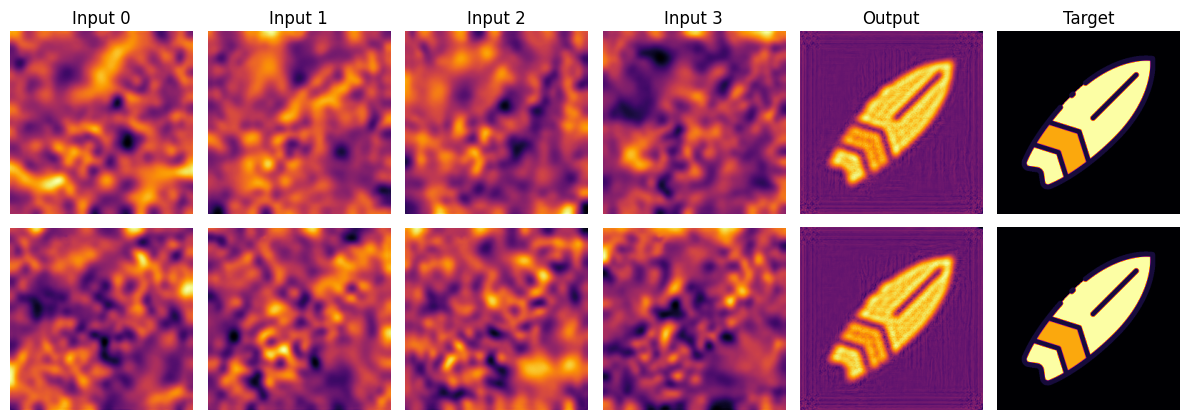
The final proof of concept demonstrated that neural networks can design optical masks that recreate a desired light pattern, marking an early step toward real-time, AI-assisted optical design. Below is an example of a generated optical output obtained from the trained pipeline.

Example of optical output generated by the AI pipeline using SLM masks. Example of optical output generated by the AI pipeline using SLM masks.